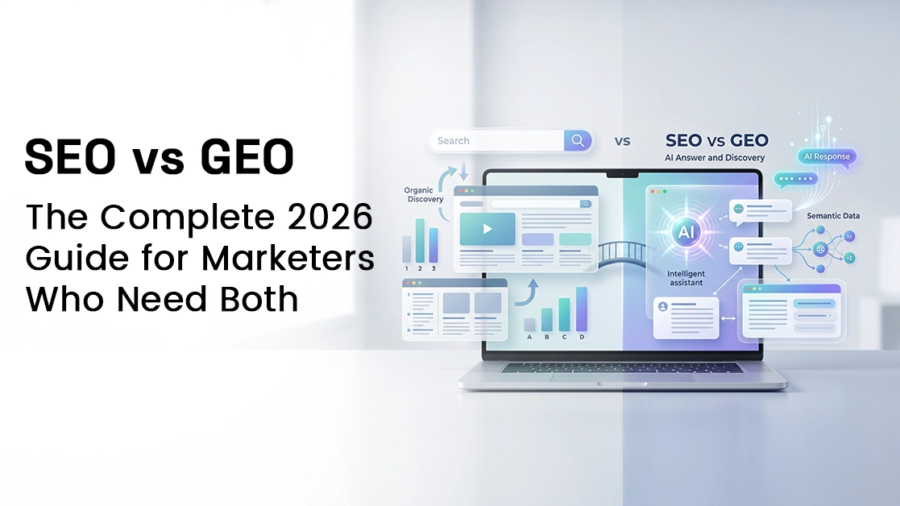

Most marketers are still arguing about Google rankings while a different kind of search engine has quietly taken over millions of decisions. ChatGPT, Claude, Gemini, and Perplexity are not just tools people use to draft emails. They are now where people go to find agencies, compare services, and decide who to trust. And these models are drawing from a completely different pool of sources than Google’s index.
If your content is invisible to language models, you are invisible to an entire category of buyers who will never find you through a traditional search result. That is the stakes of LLM optimization.
This article covers exactly how language models learn from web content, what format and structure they understand best, the technical signals that matter, how to get into LLM training datasets, and — critically — how to measure whether any of this is working. By the end, you will have a practical framework, not a theory.
What Is LLM Optimization — and Why It Is Not the Same as SEO
LLM SEO and traditional SEO share one goal: getting your content in front of the right audience. But the mechanics are entirely different. Understanding that difference is the starting point.
Google crawls your page, reads your HTML, checks your backlinks, and decides how to rank you in real time. Language models work differently. They learn from enormous datasets of text collected from the web during training — and then they use that knowledge to generate answers. Most of the time, they are not live-crawling the internet. They are drawing on what they were trained on.
There is a second mechanism, increasingly used in tools like Perplexity and ChatGPT’s Browse mode: retrieval-augmented generation, or RAG. Here, the model does a live search, pulls the most relevant content it can find, and uses that to construct its answer. This is where traditional SEO signals start to overlap with LLM optimization.
The implication: to be visible to LLMs, you need to be in the training data and retrievable at inference time. These require different actions. Both are worth pursuing.
How LLMs Learn from Web Content: Training vs Retrieval
The Training Phase: Where the Foundation Is Built
Large language models are trained on massive corpora of text scraped from the internet. Common Crawl — one of the most widely used sources — contains petabytes of web content collected over years. OpenAI, Anthropic, Google, and others filter, deduplicate, and weight this data to build their models.
Not all web content makes it in. Training datasets apply quality filters. Content that is well-structured, factually dense, frequently cited, and written with clear authority is more likely to pass those filters. Thin pages, spammy content, and pages with no external citations are more likely to be excluded or down-weighted.
This is why content authority — the same thing that drives Google rankings — is also a factor in LLM training data inclusion. The mechanisms differ but the underlying signal is similar: does this content demonstrate genuine expertise?
The Retrieval Phase: Where Real-Time Visibility Happens
When a language model is connected to live search (as in Perplexity, or ChatGPT with browsing enabled), it retrieves content at the moment of the query. The retrieval system typically runs a search against indexed web content, ranks results by relevance, and pulls the top sources into the model’s context window.
At this stage, traditional SEO signals matter more directly. Ranking on page one for a relevant query increases the probability of your content being retrieved and cited. But there is an additional layer: models prefer content that is unambiguous, structured, and directly answers the question. A page that ranks fourth but has a clean, quotable answer may be cited more than the page that ranks first with a wall of text.
The practical takeaway: optimize for training data quality and for retrieval clarity. These are not competing goals — they reinforce each other.
What Content Formats LLMs Understand and Prefer
Structured, Declarative Prose Outperforms Vague Generalism
LLMs are pattern-matching machines trained on human language. They are better at extracting meaning from content that is specific, declarative, and structured than from content that hedges, qualifies, and says very little. “Content marketing drives inbound leads” is a vague claim. “For B2B companies with a content strategy, organic search generates 3× more leads per rupee than paid acquisition at the same conversion rate” is a specific, citable claim.
Specificity is what gets cited. Vague content gets absorbed into background noise.
Question-and-Answer Structures Are Highly LLM-Readable
When a user asks an LLM a specific question, the model is looking for content that directly answers it. Pages structured with clear questions as subheadings, followed by direct answers, are optimized for this retrieval pattern. This is not a coincidence — it is also what wins featured snippets on Google.
FAQ sections, definitional blocks, and structured how-to content all perform well in LLM retrieval because they mirror the query-response format the model is trying to replicate.
Original Data, Case Studies, and Cited Research
Language models are trained to attribute information. Content that contains original data, named case studies, and cited statistics is more likely to be referenced because it provides something the model cannot generate from its general training alone. If your agency publishes original benchmark data, that data becomes a citable source. Generic commentary does not.
This is one of the clearest ways to differentiate your content in an LLM-dominated search environment: produce content that contains information LLMs cannot synthesize from elsewhere.
Technical Signals: Markup, Structure, and Internal Linking for LLMs
Semantic HTML and Schema Markup
LLMs — and the search systems that feed retrieval-augmented models — parse HTML to understand content structure. Semantic markup (H1, H2, H3 used correctly, not decoratively) helps models understand the hierarchy of your content. A page where the H2 headings map cleanly to the questions a user might ask is structurally readable in a way that benefits both Google and LLMs.
Schema.org structured data is increasingly relevant. Article schema, FAQ schema, HowTo schema, and Organization schema all help models identify what your content is, who produced it, and how it is structured. Adding Article schema with an author, publisher, and dateModified field signals credibility and recency — two factors that matter in training data filtering.
Author Authority Signals
Training datasets and retrieval systems both weight content by source authority. Author pages with genuine credentials, clear topical expertise, and links to external profiles (LinkedIn, academic profiles, industry publications) increase the authority signal of the content they are associated with. Anonymous content, or content with no clear author, has a lower authority signal.
This is not about gaming the system. It is about making your genuine expertise legible to a system that is trying to identify trustworthy sources.
Internal Linking and Content Clusters
Well-structured internal linking helps LLMs understand the topical depth of your site. A hub-and-spoke content model — where a comprehensive pillar article links to deeper sub-topic articles — signals that your site is a serious, comprehensive resource on a given topic. Models trained on web data will encounter this cluster structure repeatedly, reinforcing the association between your domain and that topic.
Keep anchor text descriptive and topically relevant. “Learn more here” tells the model nothing. “Our guide to AI-first marketing strategy for B2B brands” tells the model exactly what the linked content covers.
Page Speed, Crawlability, and Canonical Tags
Training crawlers, like search engine crawlers, follow technical rules. Blocking crawlers in your robots.txt file (whether intentional or not) prevents your content from being included in training datasets. Canonical tags ensure that duplicate content does not dilute your signal. And fast, technically clean pages are indexed and retrieved more reliably than slow or broken ones.
Run a technical SEO audit — the same improvements that help Google help LLMs. They read the same signals.
How to Get Into LLM Training Datasets
Target Sources That Are Disproportionately Represented in Training Data
Common Crawl, Wikipedia, Reddit, GitHub, and high-authority news and publication sites are heavily represented in most LLM training datasets. Content that appears on or is cited by these sources has a higher probability of being included. Getting a mention in a reputable industry publication, having your data cited in a Wikipedia article, or being discussed in a high-quality Reddit thread (r/marketing, r/SEO, r/startups) all create pathways into training datasets.
This is why digital PR — earning citations and mentions in authoritative publications — has become a core LLM SEO strategy. It is not just about backlinks for Google anymore.
Publish Genuinely Original, Citable Content
Training data filters reward originality. Rehashed listicles that combine ten other listicles are down-weighted. Original survey data, proprietary frameworks, distinctive points of view, and content that gets cited and linked to from other high-authority sources is up-weighted.
For agencies like Till.It.Clicks, this means: publish your actual thinking. If your team has a view on how AI is changing content marketing strategy in India, write it up and defend it with real evidence. That is citable content. A post titled ‘Top 10 AI Marketing Tips’ is not.
Establish Topical Authority Through Volume and Depth
Models learn associations between domains and topics through repeated exposure. If your site consistently publishes high-quality content on AI-first marketing, LLM optimization, and generative engine optimization — and that content earns citations and links — the model begins to associate your domain with that topic cluster. This is a long-term play, not a one-post fix.
Commit to a content cluster. Publish ten high-quality articles on a topic, not one article and nine social posts. The signal builds through volume and consistency.
Measurement: Checking If LLMs Reference Your Site
Direct LLM Querying
The most immediate method is manual: ask the major LLMs directly. Search ChatGPT, Claude, Gemini, and Perplexity for queries your target audience would use and see if your brand or content is mentioned. “Which marketing agencies in Pune specialize in AI-first marketing?” “What is LLM optimization?” “Who are the experts on GEO for Indian brands?”
Note which queries surface your content, which do not, and which surface competitors instead. This qualitative audit is your baseline. Run it quarterly as your content strategy develops.
Tracking Referral Traffic from AI-Adjacent Sources
Tools like Perplexity and ChatGPT Browse generate referral traffic when they cite sources. Monitor your Google Analytics for referral traffic from ‘perplexity.ai’, ‘chatgpt.com’, and similar sources. An increase in referral traffic from LLM-adjacent sources is a direct signal that your content is being retrieved and cited in responses.
This is imperfect — LLM citations do not always generate clicks — but it is a measurable proxy for retrieval visibility.
Brand Mention Monitoring
Emerging Specialist Tools
A category of tools specifically designed to measure LLM visibility is emerging. Platforms like Profound, Goodie.ai, and others are building dashboards that track brand mentions across LLM outputs at scale. These are early-stage, but investing time in understanding them now puts you ahead of the measurement curve before this becomes standard practice.
Expect this tooling to mature quickly — the same way rank tracking tools matured after early SEO became mainstream. Get familiar with the category now.
The Brands That Win LLM Visibility Are Building It Now
LLM optimization is not a future concern. It is a present one. The models currently deployed — ChatGPT, Claude, Gemini, Perplexity — are already influencing how buyers research agencies, evaluate services, and decide who to trust. The brands that appear in those responses are earning authority that their competitors are not building.
The foundation is the same as it has always been: produce content that is genuinely useful, structurally clear, technically accessible, and consistently associated with a specific topic area. LLM optimization is not a replacement for good content strategy. It is the extension of it into a new distribution layer.
The practical priority list: audit your technical markup, build a content cluster with genuine depth, earn citations in authoritative publications, and run quarterly LLM visibility checks. None of this requires a budget increase. It requires a strategic shift in how you think about who is reading your content — and what they are looking for.
Want to see what AI-first content strategy looks like in practice?
Till.It.Clicks builds content strategies for ambitious Indian businesses that are designed to perform on Google and inside language models. If your marketing agency is still optimising only for search rankings, you are already behind the curve. Let’s talk about building content that gets cited, not just ranked.
-Book a free strategy conversation at tillitclicks.com